Kitchen worktop: which material to choose (and why).
From laminate to steel, six families of worktops compared: what to really expect from each, without myths or scaremongering. Because the right worktop isn't the most expensive — it's the one that suits the way you cook.
Habitat Magazine · GuidesJuly 20266 minutes read
The most mistreated surface in the home
The worktop is the hardest-working part of the kitchen. Chopping boards, boiling pots, dripping coffee, squeezed lemon, a glass of wine forgotten overnight. No other surface in the home endures as much.
That is why there is no such thing as the best material. There is the right one for you: someone who fries and makes preserves has different needs from someone who lives the kitchen mainly as a place to be together. Here are the six families of worktops we offer every day in the showroom — laminate, HPL, ceramic, quartz, natural stone and steel — with their real strengths and limits.
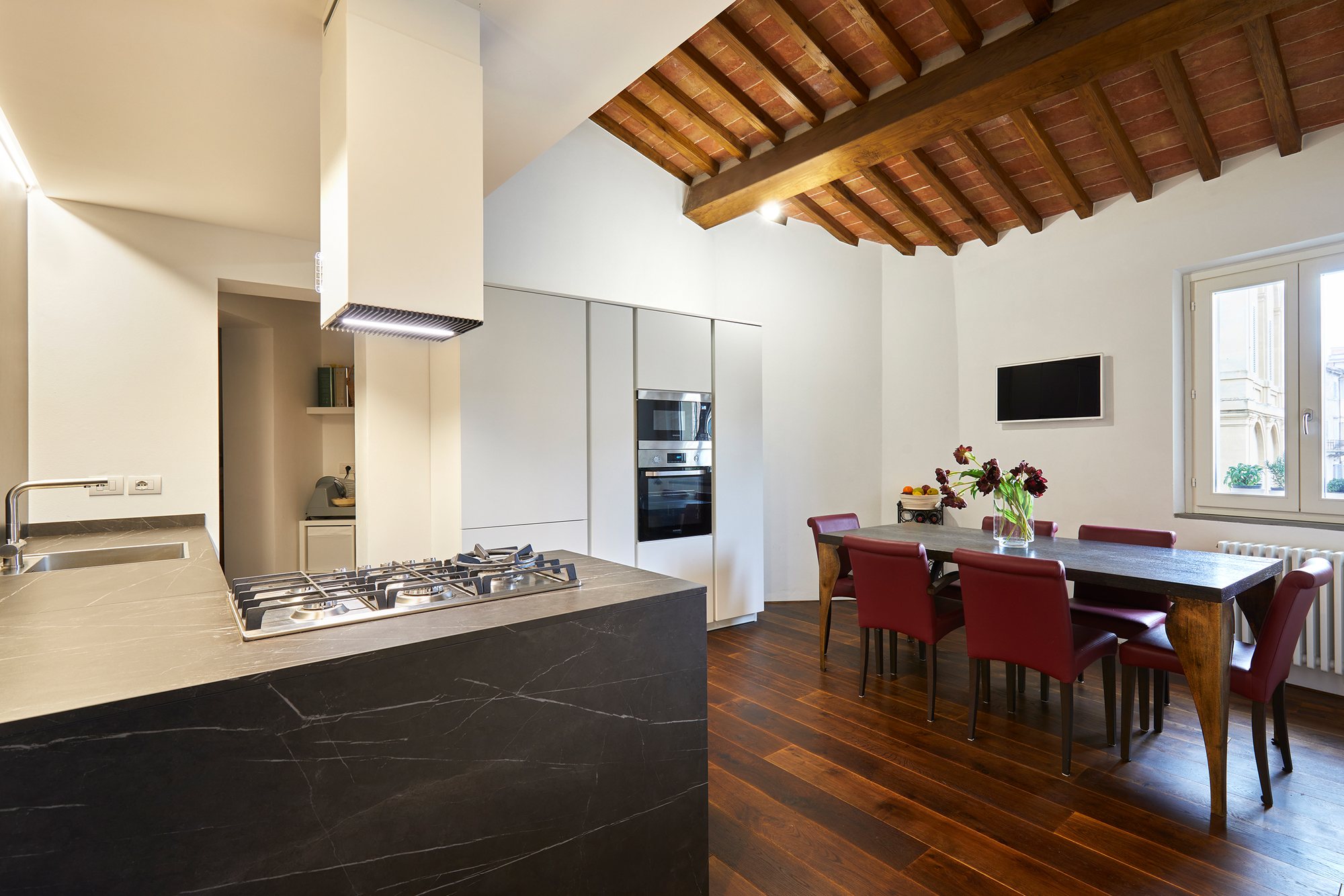
Island with dark worktop and dining area, from one of our projects in the province of Siena.
Laminate: the smart starting point
A support panel finished with a decorative laminated paper. It is the most widespread worktop and the one with the best ratio between cost and looks.
Strengths — the lowest cost for the same visual effect; almost infinite finishes (wood effect, stone effect, solid colours, matt anti-fingerprint surfaces); simple care, water and a neutral detergent.
Weak points — it fears a boiling pan placed directly on it; if water sits along the edges the panel underneath can swell, so sealing around the sink is decisive; a deep scratch cannot be repaired.
Ideal for those who want aesthetic freedom and prefer to spend the budget elsewhere, for a first home or for those planning to renovate in ten-fifteen years.
HPL: the laminate that really works
Sheets of paper impregnated with resins and pressed together at very high pressure and temperature — hence the name High Pressure Laminate. In its compact version it is a solid slab with no panel underneath: the same look as laminate, an entirely different resistance.
Strengths — far more resistant to scratches, knocks and moisture than traditional laminate; in the compact version the colour runs right through the thickness and the edge stays clean, with no joints for water to get into; slim thicknesses for a lighter-looking worktop.
Weak points — it costs more than laminate; here too a red-hot pan needs a trivet; on dark compact surfaces fingerprints show.
Ideal for those who want the visual freedom of laminate with heavy-use resistance, and for slim designer worktops around the sink.
Ceramic: peace of mind
A ceramic body fired at very high temperature until it becomes a compact, almost non-absorbent slab — large-format porcelain stoneware. The latest slabs reproduce marbles and stones with remarkable fidelity.
Strengths — it withstands heat, scratches, acids and sunlight well: coffee, wine and lemon don't stain it; it allows the aesthetics of marble without its delicacy.
Weak points — edges and corners are the sensitive spot: a sharp knock with a cast-iron pot can chip them, and invisible repair is difficult; the processing requires specialised craftsmen — the quality of installation matters as much as the slab.
Ideal for those who cook a lot and want no worries, and for those who want a marble effect to use without concern.
Engineered quartz: practical and uniform
It is an agglomerate of natural quartz — about ninety percent — bound with resins and pigments.
Strengths — a non-porous surface: stains stay on top and clean off; very resistant to everyday scratches; uniform colour and texture, what you see in the showroom is what you'll get.
Weak points — the resins fear heat: a pot straight off the burner can leave a permanent mark (the trivet here is not optional); some light shades can shift with direct, prolonged sunlight.
Ideal for families with a much-lived kitchen, for those seeking practicality and a clean, homogeneous look.
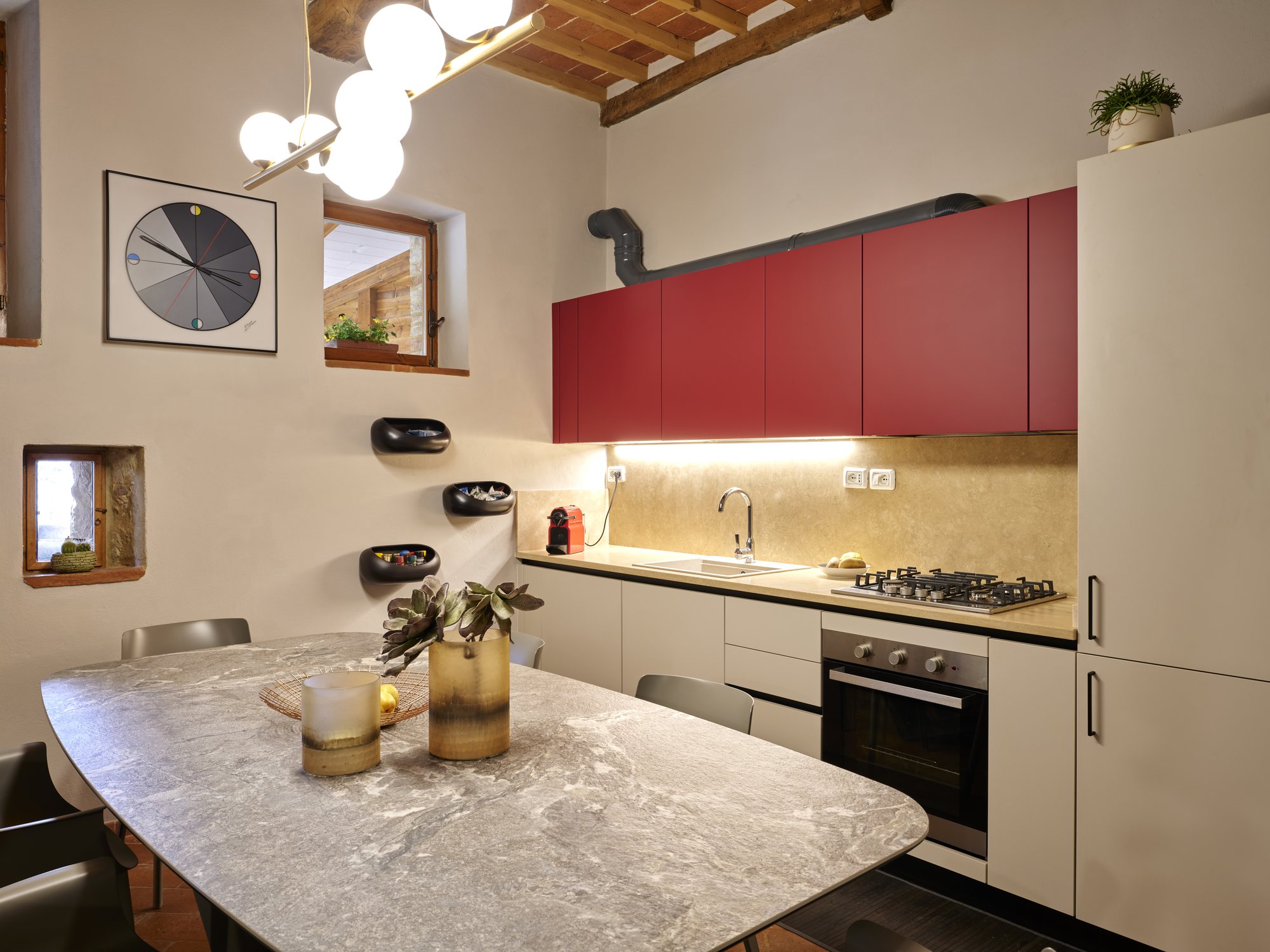
Backlit travertine splashback and light worktop: stone where it's not mistreated, from one of our projects.
Natural stone: marble and granite, living material
They are slabs cut directly from the quarry block. Each piece is unique and unrepeatable.
Strengths — a depth of veining and light that reproductions approach but never fully match; granite is hard, barely porous, and resists heat and scratches well; marble ages gaining a patina — for many a virtue, not a flaw.
Weak points — marble is sensitive to acids: lemon, vinegar and wine dull the surface where they touch, and the mark remains even with treatments; both require periodic water-and-oil-repellent treatment; marble scratches fairly easily.
Ideal for those who love living materials and accept that they tell the years. Granite, in particular, for those who want real stone with less care.
Stainless steel: the professional standard
It is a sheet of stainless steel bent and welded onto the support, often with the sink integrated in a single piece.
Strengths — it is the material of professional kitchens: hygienic and easy to sanitise; indifferent to heat and water; worktop and sink without joints where dirt can hide.
Weak points — it scratches easily: over time a lived-in satin finish forms, which you have to love; it shows fingerprints and water marks; it can dent with hard knocks.
Ideal for those who really cook, and a lot, for those who love the professional look, or paired with wood to warm up its character.
The table to decide at a glance
Material
Heat
Scratches
Stains and acids
Maintenance
Laminate
●
●●
●●
●●●
HPL
●●
●●●
●●●
●●●
Ceramic
●●●
●●●
●●●
●●●
Engineered quartz
●
●●●
●●●
●●●
Marble
●●
●
●
●
Granite
●●●
●●●
●●
●●
Stainless steel
●●●
●
●●●
●●
● = needs care · ●●● = worry-free. On budget, in relative bands: laminate at entry level, HPL and steel in the middle band, quartz medium-high, ceramic and natural stone at the top — and remember that cuts, holes and edges cost as much as the slab itself.
From the showroom · three tips we always give
The lemon on the marble. To a client in love with white marble we gave a sample and half a lemon, to leave in contact overnight. He came back with clear ideas: marble-effect stoneware for the worktop, real marble for the table. A concrete test is worth more than any data sheet.
The pot on the laminate. The damage we see most often is not the scratch, but the heat mark next to the hob. If you know you'll put the pot down wherever it lands, choose materials that don't fear heat — or at least an insert near the burners.
Samples at home. Take samples away and put them to the test with coffee, red wine and oil, left overnight. As the sample behaves, so will the worktop. Our brands provide them exactly for this.
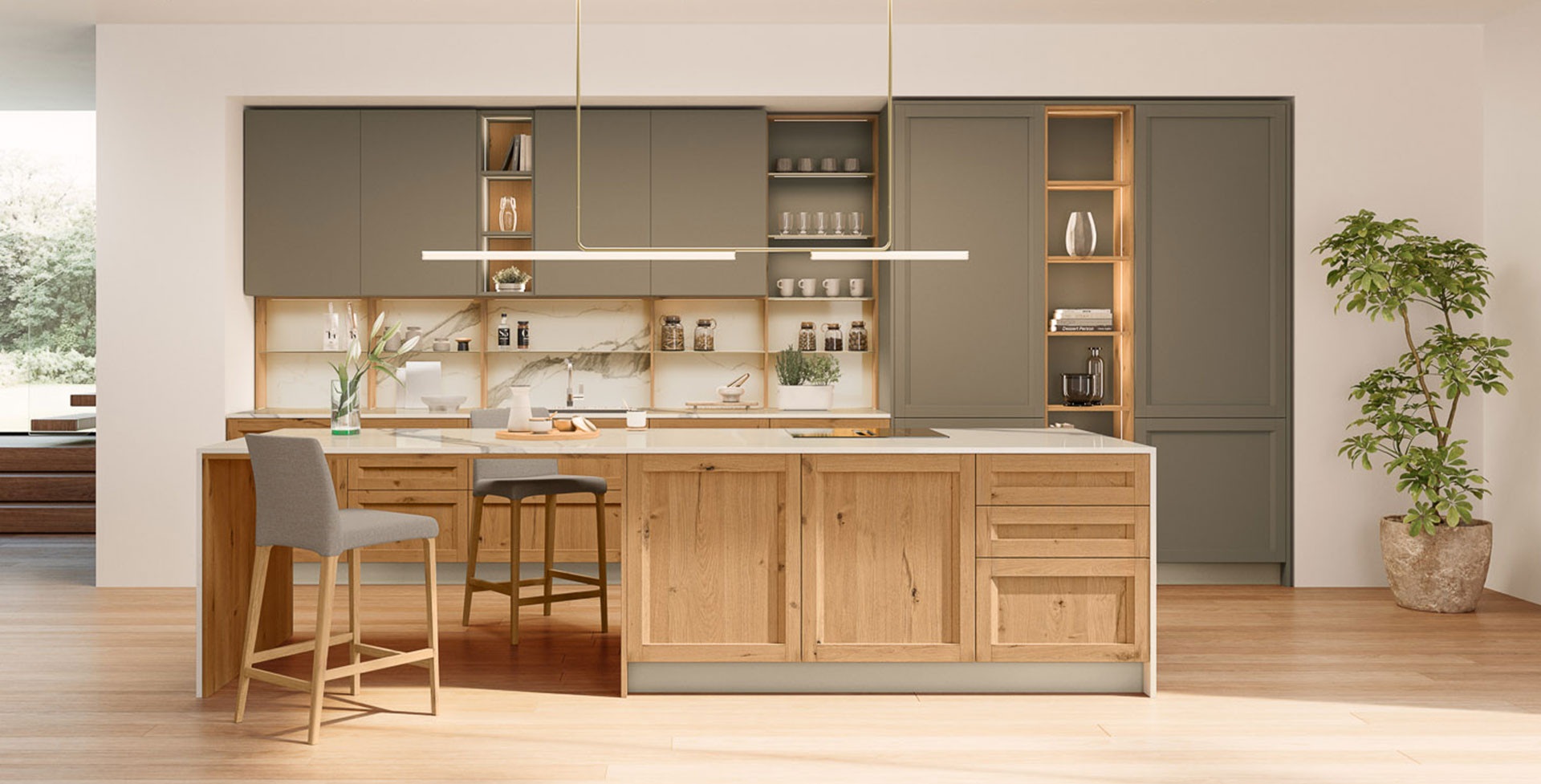
Oak island and light worktop: materials are also chosen for how they live together.
Come and touch
A kitchen worktop is chosen with the eyes, but above all with the hands. In the Materioteca of our Asciano showroom you can compare laminates, stoneware, quartz, stones, steel and wood side by side, in natural light. And at the Veneta Cucine store in Siena — the most visited single-brand store in the city — you'll see every material already installed on real kitchens.
We've been here since 1962. Come and visit us: the coffee for the stain test is on us.